2026, 47(4): 391-403.
doi: 10.21656/1000-0887.470101
Abstract:
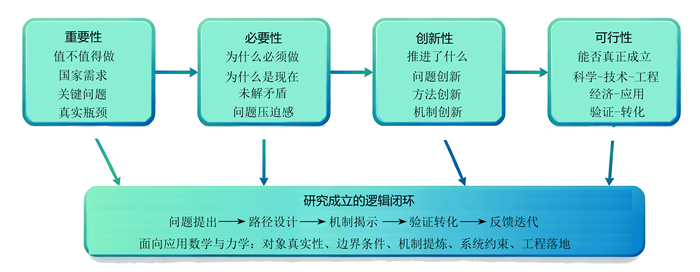
Presently, scientific research is becoming increasingly active, interdisciplinary integration is deepening, and artificial intelligence is rapidly entering knowledge production, reconsidering what truly constitutes high-quality research has become a matter of immediate practical relevance. This paper argues that scientific research should uphold four essential criteria: significance, necessity, originality, and feasibility. Significance asks whether a study is worth pursuing; necessity asks why it must be undertaken and why now; originality concerns what substantive advance it makes; and feasibility asks whether its outcomes can truly stand and be translated under scientific, technical, engineering, economic, and practical constraints. These four criteria are not isolated labels, but form a logical chain from problem formulation to the establishment of credible results. Several tendencies in current research practice deserve particular caution: replacing judgment on scientific problems with journal labels and impact factors, reversing research logic by chasing international trends and top-tier journals, packaging marginal variations as originality, and presenting ideas that lack object constraints, manufacturability, cost awareness, durability assessment, and application compatibility as "frontier breakthroughs." In the age of artificial intelligence, big data, and automated research, results can be generated faster, appearances of completeness can be produced more easily, and ideas can be packaged more persuasively; reiterating these four criteria is therefore not a conservative reaction against new tools, but a basic safeguard against the deviation of scientific judgment by formal abundance. For Applied Mathematics and Mechanics, reaffirming the four criteria also means clarifying the journal's orientation: mechanics should remain the point of application, engineering goals the central guide, and applied mathematics a source of essential methodological support.