2026, 47(8): 959-977.
doi: 10.21656/1000-0887.472064
Abstract:
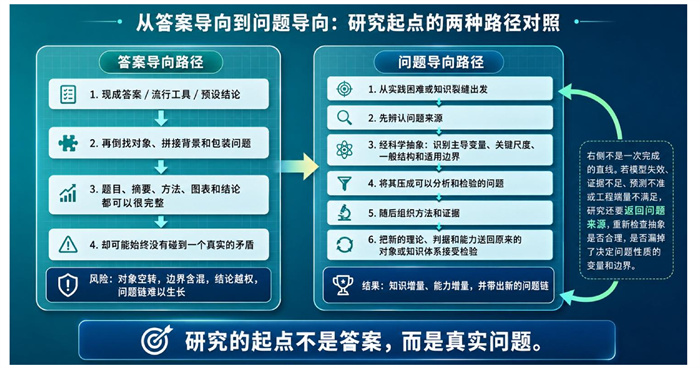
Previous editorials of this journal have discussed academic lineage, intelligent tools, criteria for evaluating research, disciplinary direction, and human development in an age of increasingly powerful tools. A more prior question must now be asked: what gives a study the right to begin, and under what conditions does its underlying question genuinely stand?Research should begin neither with an answer nor with a tool, a fashionable topic, or conceptual packaging. It should begin with a genuine question. Yet national needs, engineering bottlenecks, anomalous observations, failures of real objects, and gaps in theory are sources of questions rather than their completed scientific form. A real difficulty must undergo scientific abstraction: dominant variables, controlling scales, and general structures must be identified; the object, assumptions, boundaries, and evidential pathway must be specified; and the difficulty must be transformed into a proposition that can be analysed, modelled, tested, and, where appropriate, transferred beyond its original setting. A difficulty without abstraction remains a difficulty, while abstraction detached from the original object may become an exercise in form alone. A genuine question need not correspond directly to a tangible physical object. It may arise from engineering practice and the physical world, but it may also emerge from equations, operators, variational structures, inverse problems, singular limits, and questions of stability. Its genuineness lies not in whether it refers directly to a visible object, but in whether its origin can be explained, its concepts defined, its assumptions disclosed, its reasoning or testing pathway examined, and the authority of its conclusions properly limited. Three different dimensions must be distinguished. The distinction between a minor and a major question concerns value and capacity for further growth. The distinction between a genuine and a pseudo-question concerns whether the question is well formulated and intellectually valid. The distinction between honest and fabricated research concerns whether the object, data, images, proof, and evidence are authentic. A minor question may be entirely genuine. A pseudo-question arising from incomplete understanding may sometimes be corrected by reformulation and boundary clarification. A fabricated problem setting supported by invented objects, distorted data, or untraceable evidence belongs to a different category and must be excluded from academic inquiry.For mechanics, a question must ultimately return to the object, variables, loads, boundaries, responses, mechanisms, failure, and validation. For applied mathematics, it must return to definitions, assumptions, mathematical structures, solvability, stability, convergence, identifiability, and error bounds. Artificial intelligence may broaden searches and accelerate computation, proof exploration, and expression, but it cannot assume responsibility for deciding whether a question is worth asking, carrying out the necessary scientific abstraction, or defining the authority of proof and evidence. Research begins with genuine questions, and so should academic judgment in journals and research training in universities.