


Analysis of Compressive Behaviors of Concrete Mesoscale Models Based on the SISSO Algorithm
-
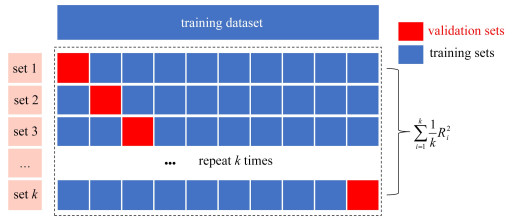
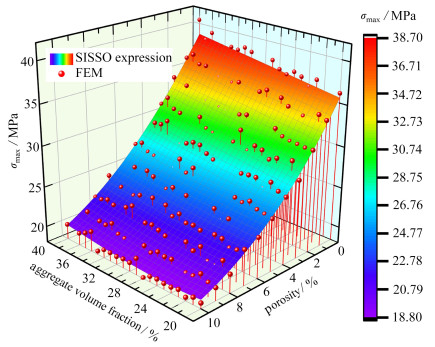
摘要: 混凝土在外载荷作用下的力学性能受细观组分特性影响,其典型非均质性使得传统实验或数值方法难以揭示细观结构对宏观力学性能的影响规律.为有效分析混凝土骨料-砂浆-孔隙三相细观模型在单轴压缩下的峰值应力,使用PYTHON和ABAQUS构建混凝土细观模型的二次开发框架,生成了包含不同骨料体积分数、孔隙率和受压峰值应力的模型数据集.基于固定描述符压缩筛选(sure independence screening and sparsifying operator, SISSO)的机器学习算法,结合K折交叉验证筛选最优物理描述符,给出了不同骨料体积分数与孔隙率对峰值应力的影响公式.该公式不仅可准确计算目标参数,还具备一定物理意义,能够清晰描述峰值应力的变化趋势.与传统机器学习算法相比,SISSO在保证精度的同时具有计算成本低、可解释性高的明显优势,克服了经典机器学习的“黑盒”局限性,为复合材料的多尺度力学分析提供了新方法.Abstract: The mechanical properties of concrete under external loads are influenced by its mesoscale components. Due to their heterogeneity, experimental and numerical methods struggle to reveal the impacts of mesoscale structures on the macroscopic mechanical behaviors of concrete. To effectively predict the peak stress of a 3-phase (aggregate, mortar and voids) mesoscale model of concrete under uniaxial compression, a framework for mesoscopic concrete was established with PYTHON and ABAQUS, to generate a dataset of models with varying aggregate volume fractions, porosities and peak compressive stresses. The sure independence screening and sparsifying operator (SISSO) machine learning algorithm, combined with the K-fold cross validation for hyperparameter optimization, was employed to derive a formula describing the effects of the aggregate volume fraction and the porosity on the peak stress. The formula accurately describes the peak stress variation trend, thereby achieving precise predictions and offering physical interpretability. Compared to traditional machine learning algorithms, the SISSO demonstrates advantages of maintaining precision while reducing computation costs and improving interpretability. It overcomes the "black box" limitations of conventional methods, offering new insights for multiscale mechanical analyses of composite materials.
-

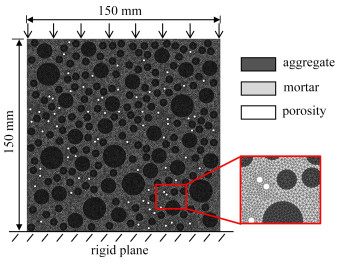
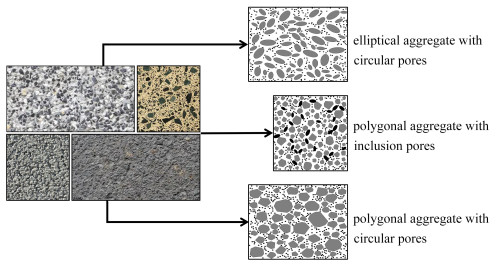
图 1 不同类型的混凝土细观形态
注 为了解释图中的颜色,读者可以参考本文的电子网页版本,后同.
Figure 1. Different types of meso-scale concrete


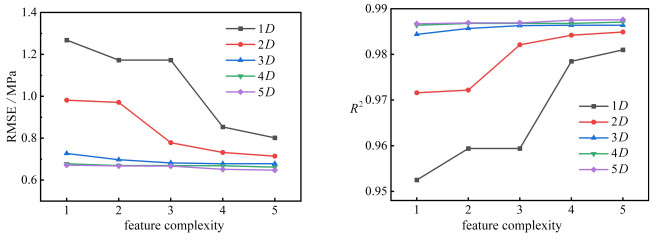
图 5 不同特征复杂度和维数下SISSO模型的预测性能
Figure 5. Performances of the SISSO model with different values of feature complexity and dimension

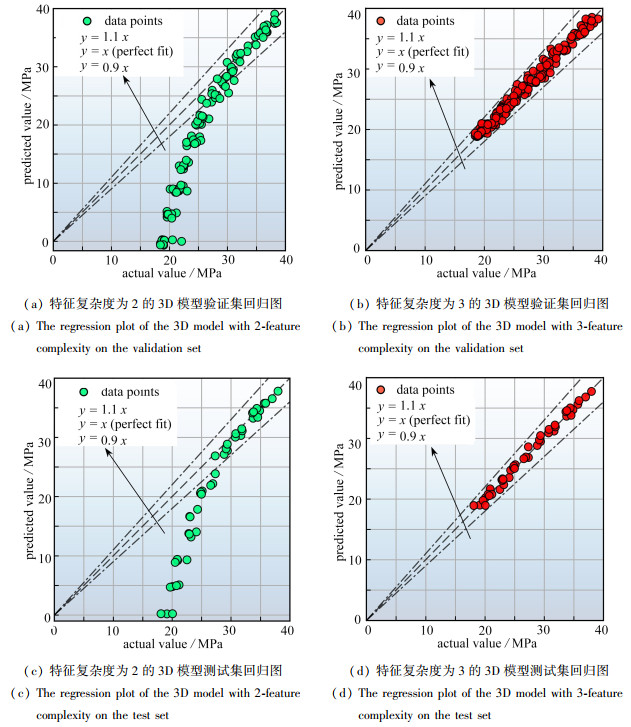
图 7 不同特征复杂度下SISSO模型的预测表现
Figure 7. SISSO model prediction performances under different-feature complexities

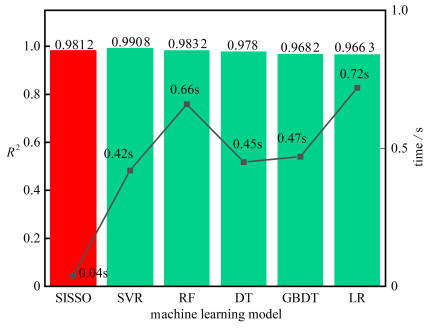
图 9 不同算法在测试集上的R2与计算时间
Figure 9. R2 values and computation durations of different algorithms on the test set
表 1 骨料和砂浆的力学参量
Table 1. Mechanical parameters of aggregate and mortar
compressive strength/MPa density /(kg·cm-3) dilatancy angle/(°) elasticity modulus/GPa eccentricity/(%) stress ratio Poisson’s ratio aggregate - 2.67 - 43 - - 0.23 mortar 35 2.40 38 25 0.1 1.16 0.2  下载: 导出CSV
表 2 文献中混凝土单轴压缩的试验参数[36]
Table 2. Experimental parameters for uniaxial compression tests on concrete[36]
parameter symbol/unit value concrete compressive strength FC/MPa 35.46 water-cement ratio w/c 0.37 coarse aggregate particle size d/mm 5~20 specimen size l/mm 150×150×300 cement density ρc/(g·cm-3) 3.1 coarse aggregate density ρm/(g·cm-3) 2.71 mortar elasticity modulus Em/GPa 23 concrete elasticity modulus Ec/GPa 32.4 mortar Poisson’s ratio υm 0.2 coarse aggregate Poisson’s ratio υc 0.2
下载: 导出CSV
表 3 特征复杂度为2时10折验证识别的描述符
Table 3. Descriptors identified through 10-fold cross validation with 2-feature complexity
frequency 1st descriptor 2nd descriptor 3rd descriptor 4 Pp+PaPp e2Pa e-Pp2 1 e-3Pp Pa+Pp2 $ \frac{P_{\mathrm{p}}^2}{P_{\mathrm{a}}}$ 1 Pa+Pp2 2Pa+Pp $\frac{P_{\mathrm{p}}^2}{P_{\mathrm{a}}} $ 1 Pp+PaPp PaePa e-Pp2 1 Pp+PaPp Pp3-Pa Pp2-Pa 1 Pp+PaPp Pa3/2 e-Pp2 1 $\frac{P_{\mathrm{p}}}{\mathrm{e}^{p_{\mathrm{a}}}} $ Pa+Pp2 2Pa+Pp
下载: 导出CSV
表 4 特征复杂度为3时10折验证识别的描述符
Table 4. Descriptors identified through 10-fold cross validation with 3-feature complexity
frequency 1st descriptor 2nd descriptor 3rd descriptor 9 $\frac{P_{\mathrm{a}} P_{\mathrm{p}}}{P_{\mathrm{a}}+P_{\mathrm{p}}}$ Pa+Pp2 (Pa+Pp)Pp2 1 $\frac{P_{\mathrm{a}} P_{\mathrm{p}}}{P_{\mathrm{a}}+P_{\mathrm{p}}} $ Pa+Pp2 PaPp2
下载: 导出CSV
表 5 式(6)中的参数项(单位: MPa)
Table 5. The parameters in formula (6) (unit: MPa)
C1 C2 C3 b -283.373 15.245 738.123 32.558
下载: 导出CSV
表 6 计算环境及软硬件参数
Table 6. Computational environment and hardware/software parameters
parameter value central processing unit Intel(R) Core(TM) i7-9750H CPU @ 2.60 GHz memory RAM 8 GB graphics card NIVIDA GeForce GTX 1650 system Windows 10 environment PYTHON 3.8 Scikit-learn 0.23.2 NUMPY 1.22.4
下载: 导出CSV
-
[1] BERNARD O, ULM F J, LEMARCHAND E. A multiscale micromechanics-hydration model for the early-age elastic properties of cement-based materials[J]. Cement and Concrete Research, 2003, 33(9): 1293-1309. doi: 10.1016/S0008-8846(03)00039-5 [2] BEUSHAUSEN H, DITTMER T. The influence of aggregate type on the strength and elastic modulus of high strength concrete[J]. Construction and Building Materials, 2015, 74: 132-139. doi: 10.1016/j.conbuildmat.2014.08.055 [3] TIAN Z, YAN Y, LI J, et al. Progressive damage and failure analysis of three-dimensional braided composites subjected to biaxial tension and compression[J]. Composite Structures, 2018, 185: 496-507. doi: 10.1016/j.compstruct.2017.11.041 [4] AHMAD A, FAROOQ F, NIEWIADOMSKI P, et al. Prediction of compressive strength of fly ash based concrete using individual and ensemble algorithm[J]. Materials, 2021, 14(4): 794. doi: 10.3390/ma14040794 [5] 李向南, 左晓宝, 周广盼, 等. 混凝土多尺度应力响应方程及其数值模拟[J]. 力学学报, 2022, 54(11): 3113-3126.LI Xiangnan, ZUO Xiaobao, ZHOU Guangpan, et al. Equation and numerical simulation on multiscale stress response of concrete[J]. Chinese Journal of Theoretical and Applied Mechanics, 2022, 54(11): 3113-3126. (in Chinese) [6] KARAPIPERIS K, STAINIER L, ORTIZ M, et al. Data-driven multiscale modeling in mechanics[J]. Journal of the Mechanics and Physics of Solids, 2021, 147: 104239. doi: 10.1016/j.jmps.2020.104239 [7] LV Z, JIANG A, LIANG B. Development of eco-efficiency concrete containing diatomite and iron ore tailings: mechanical properties and strength prediction using deep learning[J]. Construction and Building Materials, 2022, 327: 126930. doi: 10.1016/j.conbuildmat.2022.126930 [8] ZHANG X, ZHAO T, LIU Y, et al. A data-driven model for predicting the mixed-mode stress intensity factors of a crack in composites[J]. Engineering Fracture Mechanics, 2023, 288: 109385. doi: 10.1016/j.engfracmech.2023.109385 [9] ZHONG W L, DING H, ZHAO X, et al. Mechanical properties prediction of geopolymer concrete subjected to high temperatureby BP neural network[J]. Construction and Building Materials, 2023, 409: 133780. doi: 10.1016/j.conbuildmat.2023.133780 [10] AHMED H U, MOHAMMED A S, MOHAMMED A A. Multivariable models including artificial neural network and M5P-tree to forecast the stress at the failure of alkali-activated concrete at ambient curing condition and various mixture proportions[J]. Neural Computing and Applications, 2022, 34(20): 17853-17876. doi: 10.1007/s00521-022-07427-7 [11] ASTERIS P G, MOKOS V G. Concrete compressive strength using artificial neural networks[J]. Neural Computing and Applications, 2020, 32(15): 11807-11826. doi: 10.1007/s00521-019-04663-2 [12] RUDIN C. Stop explaining black box machine learning models for high stakes decisions and use interpretable models instead[J]. Nature Machine Intelligence, 2019, 1(5): 206-215. doi: 10.1038/s42256-019-0048-x [13] 刘溢凡, 张杰, 张新宇, 等. 基于"AM-GoogLeNet+BP"联合数据驱动的混凝土细观模型压缩应力-应变曲线预测[J]. 力学学报, 2023, 55(4): 925-938.LIU Yifan, ZHANG Jie, ZHANG Xinyu, et al. Prediction of concrete meso-model compression stress-strain curve based on "AM-GoogLeNet+BP" combined data-driven methods[J]. Chinese Journal of Theoretical and Applied Mechanics, 2023, 55(4): 925-938. (in Chinese) [14] ZHANG C, JI J, GUI Y, et al. Evaluation of soil-concrete interface shear strength based on LS-SVM[J]. Geomechanics and Engineering, 2016, 11(3): 361-372. doi: 10.12989/gae.2016.11.3.361 [15] GKOUNTAKOU F I, PAPADOPOULOS B K. The use of fuzzy linear regression with trapezoidal fuzzy numbers to predict the compressive strength of lightweight foamed concrete[J]. Mathematical Modelling of Engineering Problems, 2022, 9(1): 1-10. doi: 10.18280/mmep.090101 [16] CHUN P J, UJIKE I, MISHIMA K, et al. Random forest-based evaluation technique for internal damage in reinforced concrete featuring multiple nondestructive testing results[J]. Construction and Building Materials, 2020, 253: 119238. doi: 10.1016/j.conbuildmat.2020.119238 [17] BEN CHAABENE W, FLAH M, NEHDI M L. Machine learning prediction of mechanical properties of concrete: critical review[J]. Construction and Building Materials, 2020, 260: 119889. doi: 10.1016/j.conbuildmat.2020.119889 [18] CUI L, CHEN P, WANG L, et al. Application of extreme gradient boosting based on grey relation analysis for prediction of compressive strength of concrete[J]. Advances in Civil Engineering, 2021, 2021(1): 8878396. doi: 10.1155/2021/8878396 [19] KOZA J R. Genetic Programming: on the Programming of Computers by Means of Natural Selection[M]. MIT Press, 1992. [20] SCHMIDT M, LIPSON H. Distilling free-form natural laws from experimental data[J]. Science, 2009, 324(5923): 81-85. doi: 10.1126/science.1165893 [21] YI R, GEORGIOU D, LIU X, et al. Mechanics-informed, model-free symbolic regression framework for solving fracture problems[J]. Journal of the Mechanics and Physics of Solids, 2025, 194: 105916. doi: 10.1016/j.jmps.2024.105916 [22] OUYANG R, CURTAROLO S, AHMETCIK E, et al. SISSO: a compressed-sensing method for identifying the best low-dimensional descriptor in an immensity of offered candidates[J]. Physical Review Materials, 2018, 2(8): 083802. doi: 10.1103/PhysRevMaterials.2.083802 [23] PURCELL T A R, SCHEFFLER M, GHIRINGHELLI L M. Recent advances in the SISSO method and their implementation in the SISSO++ code[J]. The Journal of Chemical Physics, 2023, 159(11): 114110. doi: 10.1063/5.0156620 [24] HE N, OUYANG R, QIAN Q. Learning interpretable descriptors for the fatigue strength of steels[J]. AIP Advances, 2021, 11(3): 035018. doi: 10.1063/5.0045561 [25] WEI A, YE H, GUO Z, et al. SISSO-assisted prediction and design of mechanical properties of porous graphene with a uniform nanopore array[J]. Nanoscale Advances, 2022, 4(5): 1455-1463. doi: 10.1039/D1NA00457C [26] ZHANG Y, CHEN Q, WANG Z, et al. 3D mesoscale fracture analysis of concrete under complex loading[J]. Engineering Fracture Mechanics, 2019, 220: 106646. doi: 10.1016/j.engfracmech.2019.106646 [27] 刘溢凡, 马小敏, 王志勇, 等. 基于ANN的混凝土均匀化方法解析解[J]. 应用数学和力学, 2024, 45(5): 554-570.LIU Yifan, MA Xiaomin, WANG Zhiyong, et al. Analytical solution of the concrete homogenization method based on the ANN[J]. Applied Mathematics and Mechanics, 2024, 45(5): 554-570. (in Chinese) [28] BARNES B D, DIAMOND S, DOLCH W L. Micromorphology of the interfacial zone around aggregates in Portland cement mortar[J]. Journal of the American Ceramic Society, 1979, 62(1/2): 21-24. [29] ICHINO H, KUWAHARA N, BEPPU M, et al. Effects of the shape, size, and surface roughness of glass coarse aggregate on the mechanical properties of two-stage concrete[J]. Construction and Building Materials, 2024, 411: 134296. doi: 10.1016/j.conbuildmat.2023.134296 [30] WANG X F, YANG Z J, YATES J R, et al. Monte Carlo simulations of mesoscale fracture modelling of concrete with random aggregates and pores[J]. Construction and Building Materials, 2015, 75: 35-45. doi: 10.1016/j.conbuildmat.2014.09.069 [31] 薛刚, 刘毅, 牟一飞. 基于3D细观模型的混凝土单轴拉压应力应变关系影响因素研究[J]. 材料导报, 2025, 39(15): 24060161.XUE Gang, LIU Yi, MOU Yifei. Analysis of influencing factors of stress-strain curve of three-dimensional mesoscopic concrete under uniaxial tension and compression load[J]. Materials Reports, 2025, 39(15): 24060161. (in Chinese) [32] CHEN P, LIU J, CUI X, et al. Mesoscale analysis of concrete under axial compression[J]. Construction and Building Materials, 2022, 337: 127580. doi: 10.1016/j.conbuildmat.2022.127580 [33] 肖诗云, 朱梁. 孔隙对混凝土宏观力学性质的影响[J]. 沈阳建筑大学学报(自然科学版), 2016, 32(4): 608-618.XIAO Shiyun, ZHU Liang. Study on the effects of voids on macro-mechanical properties of concrete[J]. Journal of Shenyang Jianzhu University (Natural Science), 2016, 32(4): 608-618. (in Chinese) [34] LI B, JIANG J, XIONG H, et al. Improved concrete plastic-damage model for FRP-confined concrete based on true tri-axial experiment[J]. Composite Structures, 2021, 269: 114051. doi: 10.1016/j.compstruct.2021.114051 [35] 陈青青, 张煜航, 张杰, 等. 含孔隙混凝土二维细观建模方法研究[J]. 应用数学和力学, 2020, 41(2): 182-194.CHEN Qingqing, ZHANG Yuhang, ZHANG Jie, et al. Study on a 2D mesoscopic modeling method for concrete with voids[J]. Applied Mathematics and Mechanics, 2020, 41(2): 182-194. (in Chinese) [36] 苏捷. 混凝土受压与受拉性能的尺寸效应研究[D]. 长沙: 湖南大学, 2013.SU Jie. The research on the size effect of concrete behavior in compression and tension[D]. Changsha: Hunan University, 2013. (in Chinese) [37] 胡红青, 吴邵刚, 郭治廷, 等. 基于SISSO和机器学习方法的钙钛矿结构的稳定性预测: 新型容许因子建立与验证[J]. 中国有色金属学报, 2020, 30(8): 1887-1894.HU Hongqing, WU Shaogang, GUO Zhiting, et al. New tolerance factor based on SISSO and machine learning for predicting stability of perovskite structure[J]. The Chinese Journal of Nonferrous Metals, 2020, 30(8): 1887-1894. (in Chinese) [38] 金浏, 李健, 余文轩, 等. 混凝土动态双轴拉压破坏准则细观数值模拟研究[J]. 力学学报, 2022, 54(3): 800-809.JIN Liu, LI Jian, YU Wenxuan, et al. Mesoscopic numerical simulation on dynamic biaxial tensioncompression failure criterion of concrete[J]. Chinese Journal of Theoretical and Applied Mechanics, 2022, 54(3): 800-809. (in Chinese) [39] UDRESCU S M, TEGMARK M. AI Feynman: a physics-inspired method for symbolic regression[J]. Science Advances, 2020, 6(16): eaay2631. doi: 10.1126/sciadv.aay2631 [40] 田梦云, 张恩, 曹瑞东, 等. 基于细观尺度的混凝土单轴力学性能仿真计算分析[J]. 应用力学学报, 2020, 37(3): 975-981.TIAN Mengyun, ZHANG En, CAO Ruidong, et al. Meso-scale simulation analysis of uniaxial mechanical behavior of concrete[J]. Chinese Journal of Applied Mechanics, 2020, 37(3): 975-981. (in Chinese) [41] SHALEV-SHWARTZ S, BEN-DAVID S. Understanding Machine Learning[M]. Cambridge, UK: Cambridge University Press, 2014. [42] AWAD M, KHANNA R. Efficient Learning Machines: Theories, Concepts, and Applications for Engineers and System Designers[M]. Berkeley, CA: Apress, 2015: 67-80. [43] MONTGOMERY D C, PECK E A, VINING G G. Introduction to Linear Regression Analysis[M]. Wiley, 1982. [44] QUINLAN J R. Induction of decision trees[J]. Machine Learning, 1986, 1(1): 81-106. doi: 10.1023/A:1022643204877 [45] SVETNIK V, LIAW A, TONG C, et al. Random forest: a classification and regression tool for compound classification and QSAR modeling[J]. Journal of Chemical Information and Computer Sciences, 2003, 43(6): 1947-1958. doi: 10.1021/ci034160g [46] FRIEDMAN J H. Greedy function approximation: a gradient boosting machine[J]. The Annals of Statistics, 2001, 29(5): 1189-1232. doi: 10.1214/aos/1013203450 -

计量
- 文章访问数: 204
- HTML全文浏览量: 18
- PDF下载量: 25
- 被引次数: 0

 渝公网安备50010802005915号