


Numerical Simulation of Ice Cover Growth in Water Bodies Based on the Equivalent Heat Capacity Method
-
摘要: 寒区水域在冬季常形成冰盖,冰盖的不断生长会对人类活动产生显著影响,理解与预测冰盖生长行为对预防冰害具有重要的实际意义. 冰盖生长受到众多要素的影响,目前尚未完全认识其中的机制. 为深入研究冰盖生长行为的复杂现象,建立了冰盖生长的有限元计算模型,采用等效热容法进行了冰盖生长过程的数值模拟. 通过与实验数据的对比,验证了所建模型和方法的准确性,并对是否考虑自然对流两种情况的数值计算结果进行比较分析. 应用本文方法和冻冰度日法计算了松花江某断面河冰生长的冰盖厚度,给出了两种方法的均方根误差,进一步证实了等效热容法在实际河流环境中的有效性. 研究结果表明,本文所建立的冰盖生长计算模型和数值方法能够反映热传递和流体运动等物理过程,可有效处理冰水相变问题,为考虑多物理场耦合效应进行冰盖生长过程模拟提供了一种有效方法.Abstract: In cold regions, the formation of ice covers over water bodies during winter is a common phenomenon. The continuous growth of ice covers significantly impacts human activities, making it practically important to understand and predict ice growth behavior for the prevention of ice-related hazards. Ice cover growth is influenced by multiple factors, and the underlying mechanisms have not yet been fully elucidated. To investigate the complexity of ice cover growth, a finite element computational model was established, and the equivalent heat capacity method was employed to numerically simulate the ice growth process. The accuracy of the proposed model and method was validated through comparison with experimental data. A comparative analysis was conducted between numerical results considering and neglecting natural convection. Furthermore, both the proposed method and the freezing degree-day method were applied to estimate the ice thickness at a specific cross section of the Songhua River. The root mean square errors of the 2 methods were provided, further confirming the effectiveness of the equivalent heat capacity method in real river environments. The results demonstrate that, the established computational model and the numerical approach can effectively represent physical processes such as heat transfer and fluid motion, and handle water-ice phase transition problems. This study provides an effective method for simulating ice cover growth under multi-physics coupling effects.
-
Key words:
- ice cover /
- growth process /
- numerical simulation /
- equivalent heat capacity method /
- multi-physics coupling
edited-byedited-by1) (我刊编委章青来稿) -

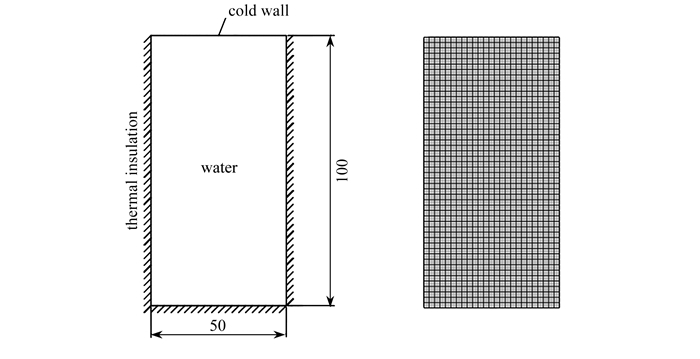
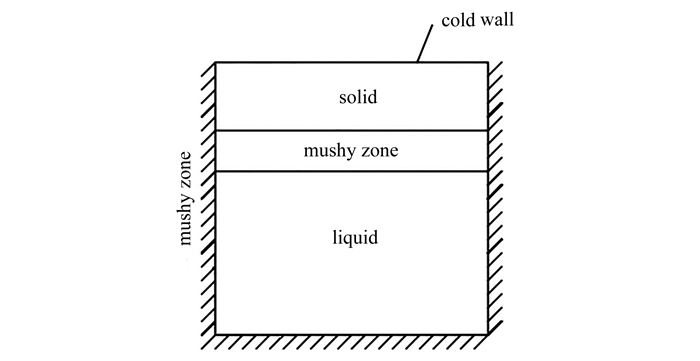
图 1 冰盖生长过程三相状态示意图
Figure 1. Schematic diagram of 3 phase states during the ice sheet growth

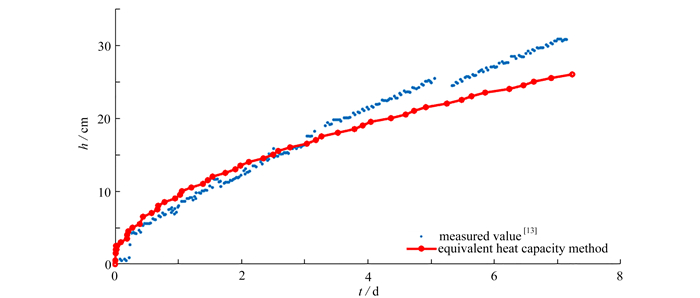
图 4 冰厚实测值与等效热容法计算所得冰厚值的比较
Figure 4. Comparison between measured ice thicknesses and calculated ice thicknesses with the equivalent heat capacity method

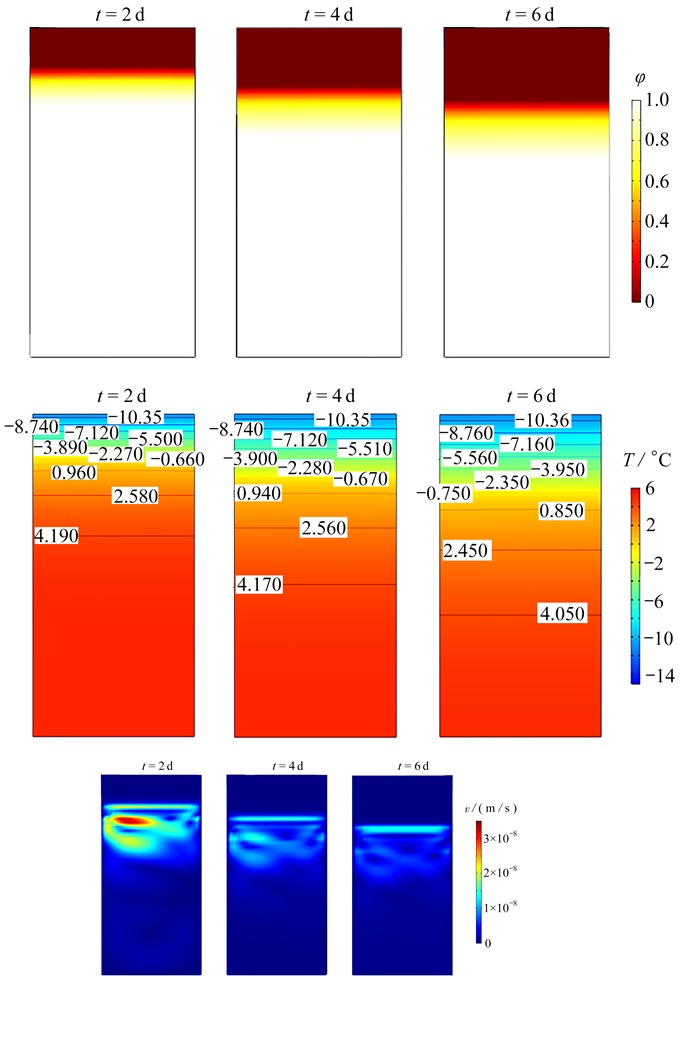
图 5 冰盖生长过程中的固液相分布、温度和流体流动速度
Figure 5. Solid-liquid 2-phase distributions, temperature contours, fluid flow velocity contours during the ice sheet growth process

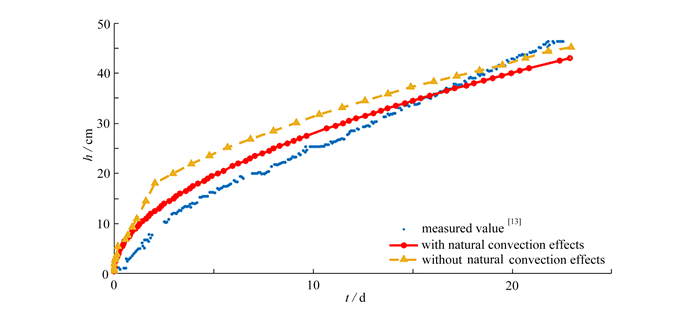
图 6 冰厚实测值与考虑自然对流和忽略自然对流计算所得冰厚值的比较
Figure 6. Comparison of measured ice thickness versus calculated results with and without natural convection effects

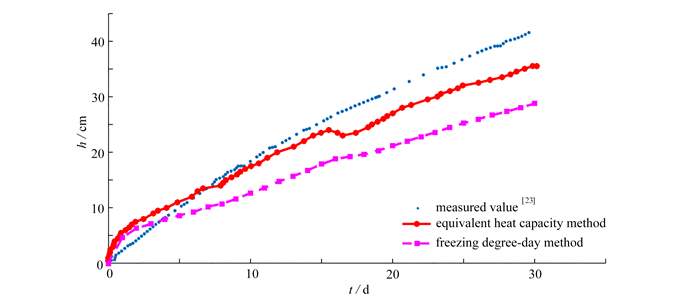
图 7 大顶子山断面河冰冰厚实测值和计算值的比较
Figure 7. Comparison of measured and calculated ice thickness values at the Dadingzi mountain cross section
表 1 计算参数
Table 1. Calculation parameters
parameter value specific heat capacity of ice cp, s/(J/(kg·K)) 2 052 specific heat capacity of water cp, l/(J/(kg·K)) 4 202 latent heat of phase change L/(J/kg) 3.35×10⁵ dynamic viscosity η/(Pa·s) 1.788×10⁻³ phase change temperature Tpc/℃ 0 thermal conductivity of ice λs/(W/(m·K)) 2.26 thermal conductivity of water λl/(W/(m·K)) 0.56 mushy zone constant Am/(kg/(m3·s)) 105 coefficient of thermal expansion β/(1/K) 10-7 density of ice ρs/(kg/m3) 917 density of water ρl/(kg/m3) 1 000  下载: 导出CSV
表 2 不同试验温度下的均方根误差
Table 2. Root mean square errors at different experimental temperatures
temperature/℃ with natural convection effects without natural convection effects -18 1.63 2.14 -20 2.99 5.57 -25 2.49 4.47 -30 0.64 0.96
下载: 导出CSV
表 3 2005年11—12月大顶子山断面封冻后地面平均温度
Table 3. Average ground temperatures after freezing of the Dadingzi mountain section from november to december 2005
date temperature/℃ date temperature/℃ 11-18 -7.5 12-03 -11.8 11-19 -6.3 12-04 -5.8 11-20 -3.6 12-05 -5.6 11-21 -4.4 12-06 -9.4 11-22 -4.0 12-07 -11.5 11-23 -3.7 12-08 -13.1 11-24 -6.5 12-09 -12.1 11-25 -3.7 12-10 -13.0 11-26 -6.8 12-11 -13.7 11-27 -8.7 12-12 -14.2 11-28 -8.4 12-13 -12.6 11-29 -11.3 12-14 -12.7 11-30 -10.1 12-15 -11.9 12-01 -11.6 12-16 -13.6 12-02 -13.3 12-17 -14.6
下载: 导出CSV
表 4 不同方法计算大顶子山断面河冰冰厚的均方根误差
Table 4. Root mean square errors of river ice thicknesses calculated with different methods at the Dadingzi mountain cross section
method equivalent heat capacity method freezing degree-day method RMSE/cm 4.92 8.05
下载: 导出CSV
-
[1] STEFAN J. Vber die theorie der eisbildung, insbesondere über die eisbildung im polarmeere[J]. Annalen der Physik, 1891, 278(2): 269-286. doi: 10.1002/andp.18912780206 [2] SHEN H T, CHIANG L A. Simulation of growth and decay of river icecover[J]. Journal of Hydraulic Engineering, 1984, 110(7): 958-971. doi: 10.1061/(ASCE)0733-9429(1984)110:7(958) [3] 秦妍, 李维仲. 利用移动网格技术模拟冰融化过程中的传热问题[J]. 热科学与技术, 2005, 4(3): 213-218.QIN Yan, LI Weizhong. Numerical simulation on heat transfer in ice melting by using moving mesh method[J]. Journal of Thermal Science and Technology, 2005, 4(3): 213-218. (in Chinese) [4] 吴兆春. 界面追踪法求解半空间双相Stefan问题[J]. 哈尔滨商业大学学报(自然科学版), 2004, 20(1): 59-62.WU Zhaochun. An approach to semi-space two-phase Stefan problems by using interface-tracking and analysis method[J]. Journal of Harbin University of Commerce (Sciences Edition), 2004, 20(1): 59-62. (in Chinese) [5] NABAVI S F, GARMESTANI H. Multi-scale modeling of metallurgical phenomena in metal laser powder bed fusion additive manufacturing: a comprehensive review[J]. Journal of Manufacturing Processes, 2025, 150: 610-644. [6] HU C, DI H, LIU X, et al. Large eddy simulation investigation of the effect of radiative heat transfer on the ignition progress in a model combustor[J]. International Journal of Heat and Mass Transfer, 2024, 231: 125822. doi: 10.1016/j.ijheatmasstransfer.2024.125822 [7] KOZAK Y. Close-contact melting of a vertical cylinder on an isothermal surface: modeling and investigation for a non-Newtonian Herschel-Bulkley fluid liquid-phase[J]. International Journal of Heat and Mass Transfer, 2024, 225: 125378. doi: 10.1016/j.ijheatmasstransfer.2024.125378 [8] ZHAO H Y, WANG X, WU J, et al. An intelligent, solar-responsive, and thermally conductive phase-change system toward solar-thermal-electrical conversion featuring daytime blooming for solar energy harvesting and nighttime closing for thermal preservation[J]. Advanced Functional Materials, 2024, 34(45): 2406236. doi: 10.1002/adfm.202406236 [9] 周业涛, 关振群, 顾元宪. 求解相变传热问题的等效热容法[J]. 化工学报, 2004, 55(9): 1428-1433.ZHOU Yetao, GUAN Zhenqun, GU Yuanxian. Equivalent heat capacity method for solution of heat transfer with phase change[J]. Journal of Chemical Industry and Engineering (China), 2004, 55(9): 1428-1433. (in Chinese) [10] 周建辉. 高温固液相变蓄热器的结构设计和数值模拟[D]. 哈尔滨: 哈尔滨工程大学, 2004.ZHOU Jianhui. Structural design and numerical simulation for a high-temperature solid-liquid phase change thermal energy storage container[D]. Harbin: Harbin Engineering University, 2004. (in Chinese) [11] MOENCH S, DITTRICH R. Influence of natural convection and volume change on numerical simulation ofphase change materials for latent heat storage[J]. Energies, 2022, 15(8): 2746. doi: 10.3390/en15082746 [12] 潘艾刚, 王俊彪, 张贤杰. 基于等效热容法和焓法的相变传热数值分析[J]. 计算机仿真, 2014, 31(2): 315-319.PAN Aigang, WANG Junbiao, ZHANG Xianjie. Numerical analysis of phase-change heat transfer characteristics using effective heat capacity method and enthalpy method[J]. Computer Simulation, 2014, 31(2): 315-319. (in Chinese) [13] 王昕. 不同种类冰的厚度计算原理和修正[D]. 大连: 大连理工大学, 2007.WANG Xin. Ice thickness calculating principle and modifying of different ice types[D]. Dalian: Dalian University of Technology, 2007. (in Chinese) [14] 李得伦. 石蜡相变材料的传热与控温性能研究[D]. 广州: 华南理工大学, 2012.LI Delun. Research on the heat transfer and thermal control performance of paraffin phase change material[D]. Guangzhou: South China University of Technology, 2012. (in Chinese) [15] 白乙拉, 李冰, 冯景山. 以气温为边界条件的水库冰盖厚度的数值模拟研究[J]. 辽宁师范大学学报(自然科学版), 2012, 35(2): 164-167.BAI Yila, LI Bing, FENG Jingshan. Study on numerical simulation of growth in thickness of ice caps in reservoirs in the boundary condition of atmospheric temperature[J]. Journal of Liaoning Normal University (Natural Science Edition), 2012, 35(2): 164-167. (in Chinese) [16] 董兴聪. 相变传热问题数值分析的自适应四叉树-比例边界元方法[D]. 大连: 大连理工大学, 2019.DONG Xingcong. Adaptive quadtree-scaled boundary finite element method for numerical analysis of heat transfer problems with phase change[D]. Dalian: Dalian University of Technology, 2019. (in Chinese) [17] 刘仍通, 潘阳. 自然对流影响结冰的数值模拟及实验研究[J]. 华东交通大学学报, 2010, 27(5): 22-27.LIU Rengtong, PAN Yang. Numerical simulation and experiment research of the impact of natural convection on ice formation[J]. Journal of East China Jiaotong University, 2010, 27(5): 22-27. (in Chinese) [18] SHEN H T, YAPA P D. A unified degree-day method for river ice cover thickness simulation[J]. Canadian Journal of Civil Engineering, 1985, 12(1): 54-62. doi: 10.1139/l85-006 [19] 丁法龙, 茅泽育. 寒区水塘冰盖生长和消融分析[J]. 水利学报, 2021, 52(3): 349-358.DING Falong, MAO Zeyu. Ice cover growth-decay process of pond in cold region[J]. Journal of Hydraulic Engineering, 2021, 52(3): 349-358. (in Chinese) [20] 冯景山, 白乙拉, 李冰. 寒区水库冰盖厚度增长数值模拟研究[J]. 渤海大学学报(自然科学版), 2011, 32(1): 5-9.FENG Jingshan, BAI Yila, LI Bing. Study on numerical simulation of growth in thickness of ice caps in reservoirs of cold regions[J]. Journal of Bohai University (Natural Science Edition), 2011, 32(1): 5-9. (in Chinese) [21] LIN L, YANG D, LUO Z, et al. Numerical study on melting and heat transfer characteristics of vertical cylindrical PCM with a focus on the solid-liquid interface heat transferrate[J]. Journal of Energy Storage, 2023, 72: 108370. doi: 10.1016/j.est.2023.108370 [22] VAKILZADEH A H, SARVESTANI A B, JAVAHERDEH K, et al. Heat transfer and fluid flow in a PCM-filled enclosure: effect of heated wall configuration[J]. Journal of Energy Storage, 2024, 87: 111448. doi: 10.1016/j.est.2024.111448 [23] 李志军, 孙万光, 许士国, 等. 短期水文气象资料估算哈尔滨至同江冰厚度[J]. 水科学进展, 2009, 20(3): 428-433.LI Zhijun, SUN Wanguang, XU Shiguo, et al. Calculating river ice thickness from Harbin to Tongjiang using short-term hydrological and meteorological data[J]. Advances in Water Science, 2009, 20(3): 428-433. (in Chinese) -

计量
- 文章访问数: 163
- HTML全文浏览量: 49
- PDF下载量: 35
- 被引次数: 0

 渝公网安备50010802005915号